How I Reached 609K Monthly Views on Pinterest in Six Weeks—with About One Minute a Day
I spent roughly a month and a half growing a Pinterest account. My daily involvement was about one minute, and the account reached 609K monthly views.
The tool behind the automation was Cloudl, the command-line tool linked to jyjyxt/cloudownloader on GitHub. It lets me turn browser actions into commands that a script or AI agent can run through my logged-in Chrome session.
That makes a repetitive publishing task much easier to maintain. Once the setup is working and the content is ready, I can spend my attention on the next item and the result instead of repeating the same browser steps.
In this article, I'll show the result, explain what the one-minute figure means, walk through installation, reproduce my connectivity and X publishing tests, and show how to build a Pinterest workflow around the same tool. I'll also cover how to extend it to multiple accounts.
The result: 609K monthly views, with seven followers
Here is the account at the time of the screenshot:
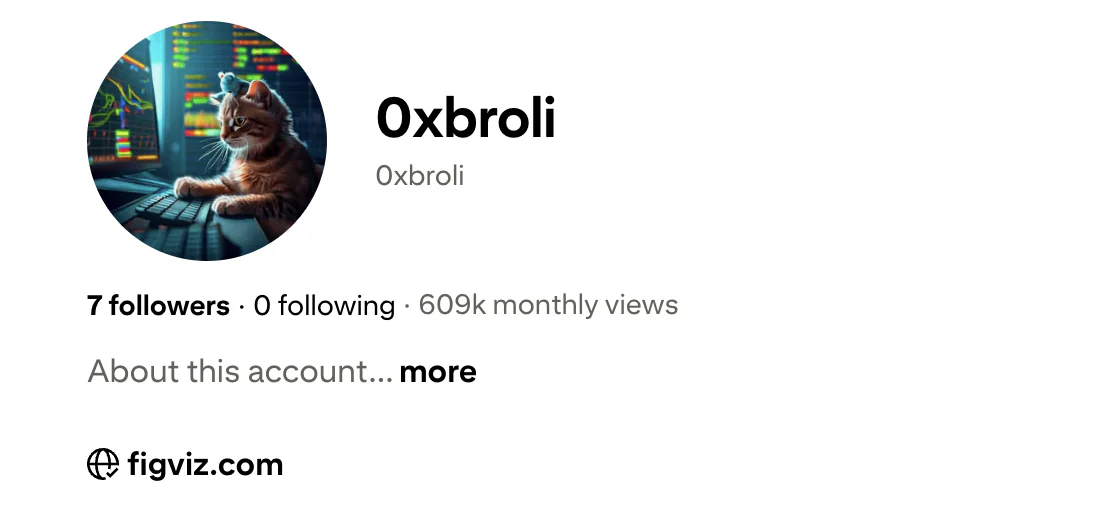
My Pinterest profile showing 609K monthly views after roughly six weeks of account building.
| Item | Result |
|---|---|
| Time spent building the account | About a month and a half |
| Typical daily involvement | About one minute |
| Monthly views shown on the profile | 609K |
| Followers shown on the profile | 7 |
| Following | 0 |
| Website linked on the profile | figviz.com |
Seeing that number with seven followers was the interesting part for me. This particular account had reached a substantial level of visibility while its follower count was still small.
The metric needs some context. 609K monthly views does not mean 609K website visits or 609K unique people. Pinterest reports impressions, audience, saves, and outbound clicks separately. Its analytics documentation defines impressions as appearances on screen and outbound clicks as actions that take people to a destination outside Pinterest. Those distinctions matter when judging business results. Pinterest's analytics guide explains the metrics.
The screenshot supports a visibility milestone. It does not establish revenue, conversion rate, or how much traffic reached my website. My six-week timeline and daily time estimate are my account of the experiment; they aren't measurements contained in the screenshot.
What “about one minute a day” actually means
The one-minute figure describes the recurring daily involvement. It excludes initial installation, building the workflow, and any separate work needed to prepare the content.
There is also a difference between my time and the computer's time. Uploading an image and waiting for a browser confirmation can take longer than the time I spend initiating or reviewing the task.
The practical arrangement is simple:
Prepare the content, let the workflow handle the browser steps, and review the outcome.
To reproduce that arrangement, keep the daily decision small: which prepared item should run next, and did the previous item publish correctly? Leave bigger tasks—preparing images, revising the workflow, and investigating failures—for separate sessions.
I wouldn't present this as a promise that anyone can get the same result in six weeks. It is one account's result. The reproducible part is the installation and operating process below.
How Cloudl connects the terminal to the browser
Cloudl's browser automation uses three pieces:
- The CLI: the
cloudlcommand you run in a terminal. - A local daemon: the process that passes requests between the CLI and browser.
- The Browser Bridge extension: the Chrome extension that carries out browser operations.
The connection looks like this:
Your command or AI agent
          |
          v
      Cloudl CLI
          |
          v
     Local daemon
          |
          v
Browser Bridge in a Chrome profile
          |
          v
 Logged-in Pinterest or X account
That Chrome profile is important: its login session determines which account the browser can operate. Keep the intended profile open and log in to the relevant website before testing.
Install Cloudl from start to finish
The commands in this walkthrough follow the documentation bundled with Cloudl v1.8.10, the version in my test. Its package metadata points to this repository.
1. Check the prerequisites
You need Node.js, npm, Git, and Chrome or a compatible Chromium browser. Cloudl v1.8.10 declares Node.js 20.18.1 or newer as its minimum; my test used v24.15.0. For a fresh setup, get a supported LTS release from the official Node.js download page.
Open a terminal and check:
node --version
npm --version
git --version
Each command should print a version. If one is missing, install it and reopen the terminal before continuing.
2. Clone the source
git clone https://github.com/jyjyxt/cloudownloader.git
cd cloudownloader
Before installing, check which package directory you are in:
node -p 'JSON.stringify({name: require("./package.json").name, bin: require("./package.json").bin}, null, 2)'
The CLI package should declare a cloudl executable in bin. The bundled documentation also describes a website workspace layout where the CLI is inside cloudl/. If your checkout has that layout, change into it first:
cd cloudl
Run the package check again there. If the checkout contains only the Next.js downloader website and no CLI package, it is not sufficient for this tutorial: obtain the CLI source revision described by the repository documentation before continuing. Installing the website package alone will not create a cloudl command.
3. Install dependencies and link the command
From the CLI package directory:
npm install
npm link
cloudl --version
cloudl --help
The documented source setup builds the CLI through the package's prepare script during installation. npm link makes the executable available in your current Node.js environment.
Keep that source directory in place because the linked command points to it. If you switch Node.js installations or move the checkout, you may need to run npm link again.
I'm using source installation here deliberately: the public npm registry returned “Not Found” for @jyjyxt/[email protected] when this guide was prepared, so a global npm package install is not a verified alternative.
4. Install the Browser Bridge extension
The simplest documented option is the prebuilt extension:
- Open the repository's Releases page.
- Download the available
cloudl-extension-v{version}.zipasset. - Extract it into a permanent folder.
- Open
chrome://extensionsin the Chrome profile you will use. - Enable Developer mode.
- Click Load unpacked.
- Select the extracted folder containing
manifest.json.
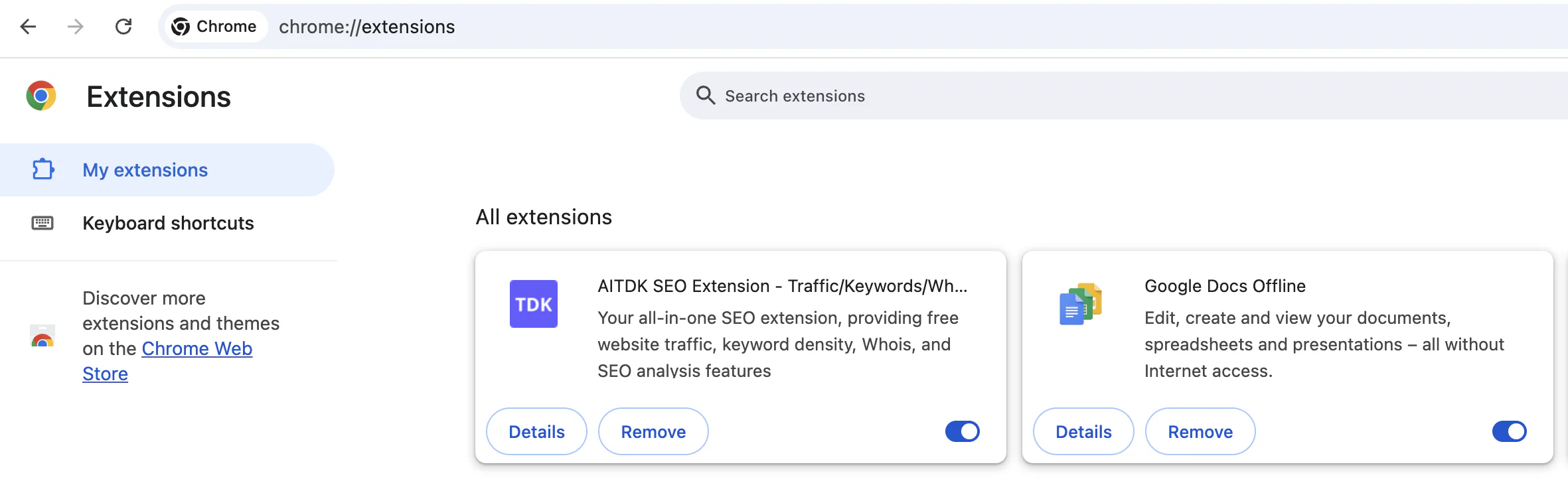
Open this page to load the Browser Bridge. This screenshot shows the extensions manager; the Cloudl extension card is not visible in it.
If you are building the extension from source instead, run these commands from the CLI source directory that contains extension/:
npm --prefix extension install
npm --prefix extension run build
Then load the extension/ directory in Chrome. That folder contains manifest.json; do not select extension/dist/.
The CLI build and extension build are separate. After changing extension code, rebuild it and click Reload on its card in Chrome. Keep the loaded folder in place because Chrome continues reading it.
5. Open the accounts you intend to use
In that same Chrome profile, log in to Pinterest. For the X test below, log in to X as well.
Keep Chrome running. The local daemon starts automatically when needed, so the next step is to check the connection.
Test one: check the connection with cloudl doctor
Run:
cloudl doctor
Here is the output from my setup:
cloudl v1.8.10 doctor (node v24.15.0)

[OK] Daemon: running on port 19825 (v1.8.10)
[OK] Extension: connected (v1.0.24)

Profiles:
  • jfgbw7qd: connected v1.0.24
[OK] Connectivity: connected in 0.0s

Everything looks good!
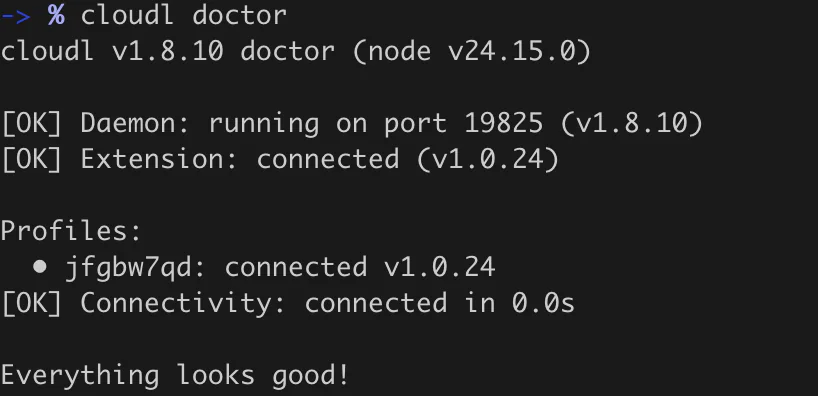
The actual connectivity check from my environment.
The daemon line confirms that the local process is running. The extension line confirms that Chrome has connected. The profile entry identifies the browser context available to Cloudl.
Your versions and profile ID may differ. The important result is a healthy connection. This check does not establish that you are logged in to Pinterest or that publishing will work; those need website-specific checks.
If the extension is disconnected, verify that it is enabled in the open Chrome profile. If the daemon needs attention, inspect and restart it:
cloudl daemon status
cloudl daemon restart
cloudl doctor
Test two: publish a real post to X
I used a short text post to test an actual publishing action:
cloudl twitter post 'Testing Cloudl: Publish directly to X from the terminal 🚀'
This command publishes a real post to the X account logged in through the selected profile. The adapter is named twitter, even though the platform is now called X.
The terminal returned success, together with the text, post ID, and URL:

The recorded command returned a successful publish result in about 5.8 seconds.
I also checked the result on X:
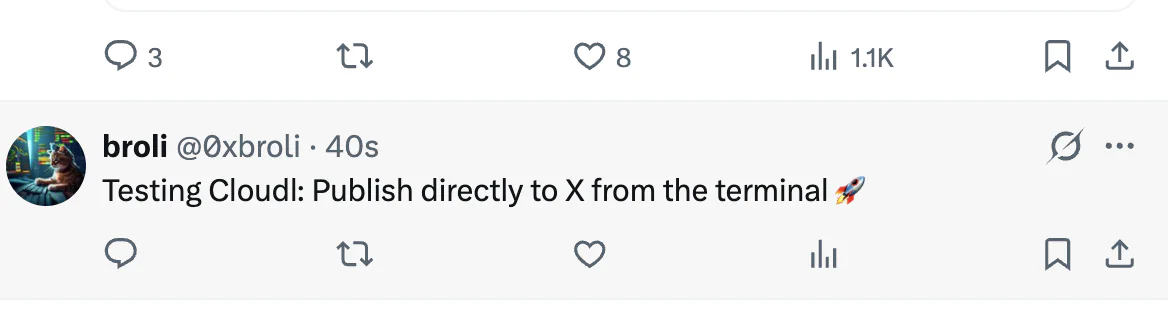
The published post in the browser. The engagement row at the top belongs to the preceding post, not this test.
That gives two useful checkpoints: the command reported success, and the post appeared on the platform. For any publishing workflow, keep the returned URL and inspect the result before scaling up.
This test confirms the X publishing path in my recorded setup. Pinterest still needs its own test.
Build the Pinterest publishing workflow
The following commands are a reproducible template based on the installed v1.8.10 command help. Replace the example username, board, image, and destination with your own values. They are not a log of every action used during my six-week experiment.
Check the account and boards
Discover the available commands first:
cloudl pinterest --help
cloudl pinterest create-pin --help
Then inspect your public profile and boards:
cloudl pinterest user YOUR_PINTEREST_USERNAME
cloudl pinterest user-boards YOUR_PINTEREST_USERNAME --limit 20
Confirm in Chrome that the logged-in account is the account you intend to publish through. Looking up a public username does not switch your login session.
Publish one prepared Pin
Prepare an image, a title, a description, the exact board name, and an appropriate destination link. Use an image you created or have permission to publish.
For example:
cloudl pinterest create-pin \
  --image "/absolute/path/to/your-pin.webp" \
  --board "Your Existing Board" \
  --title "A clear title describing your visual" \
  --description "Explain what readers will find and why it is useful." \
  --link "https://your-site.example/relevant-page" \
  --alt-text "Describe the main content of the image." \
  -f json
--image takes a local file. --board takes a board name. --link supplies the destination, and --alt-text is used when Pinterest exposes that field. JSON output makes the returned status, board, title, and URL easier for another program to read.
Open the returned Pin URL and check the image, text, board, and destination link. You can also inspect recent Pins:
cloudl pinterest user-pins YOUR_PINTEREST_USERNAME --limit 5
If publishing times out, check the account before retrying. The browser may have completed the action even if the command did not receive its confirmation.
Turn one successful run into a daily routine
Once the individual command works, prepare a small queue. Each item needs enough information to publish without another round of research:
| Field | What to store |
|---|---|
| Account/profile | Which Chrome profile should run the task |
| Image | An existing local file path |
| Board | The intended destination board |
| Title and description | Finished copy |
| Destination | The relevant page URL |
| Status | Pending, published, or needs review |
| Result | Published Pin URL or failure details |
The execution sequence can stay straightforward: read the next prepared item, publish it, capture the result, and update its status. A failed item should remain visible for review rather than silently disappearing from the queue.
For an AI-assisted version, Cloudl documents this browser skill installation:
npx skills add jyjyxt/cloudownloader --skill cloudl-browser
An example task instruction is:
Use Cloudl with the Pinterest profile specified in my queue.
Take the next prepared item and verify that its image file exists.
Publish it to the specified board using its saved title,
description, alt text, and destination URL.
Record the returned Pin URL and update the item's status.
If publishing fails or the result is uncertain, report it and stop.
Installing a skill alone does not create a queue or a schedule. Those belong in your script, task runner, or agent setup. Establish the single-item workflow first; then choose how to trigger it daily.
That is the practical route to a short daily check: review the prepared item, start or inspect the run, and look at the result. Content preparation and occasional maintenance still require their own time.
Expand the workflow to multiple accounts
Cloudl supports selecting among connected Chrome profiles. A useful arrangement is one profile per account, with the Browser Bridge installed and enabled in each.
List the connected profiles:
cloudl profile list
Assign memorable aliases using the IDs returned by that command:
cloudl profile rename YOUR_FIRST_CONTEXT_ID pinterest-main
cloudl profile rename YOUR_SECOND_CONTEXT_ID pinterest-second
Optionally set a default:
cloudl profile use pinterest-main
For repeatable jobs, specify the profile in the command itself:
cloudl --profile pinterest-main pinterest create-pin \
  --image "/absolute/path/to/main-account-pin.webp" \
  --board "Main Account Board" \
  --title "A title for the main account" \
  --description "Copy prepared for this account's audience." \
  --link "https://your-site.example/main-page" \
  -f json
Use --profile pinterest-second and that account's content and board for the second workflow. The alias selects a Chrome context; it does not create a Pinterest account or log you in automatically.
Keep each account's queue and results separate. Begin with a verified run per profile so you know the routing works. Adding accounts adds content and review work, so my one-minute estimate for one account should not be treated as a time estimate for an unlimited portfolio.
Maintenance and common problems
For a source installation, update from the existing checkout using the documented sequence:
git pull --ff-only
npm install
cloudl --version
cloudl doctor
Run the npm commands in the CLI package directory. A manually loaded extension needs its own update and Chrome reload when an extension release is required.
| Symptom | What to check |
|---|---|
cloudl: command not found | Run npm link in the CLI package using your active Node.js installation. |
| Extension disconnected | Open the correct Chrome profile and enable the Browser Bridge. |
| Login or authorization error | Log in again on the target website in that profile. |
| Wrong account used | Check the profile's actual login and pass --profile explicitly. |
| Image or board failure | Verify the local file and exact board name. |
| Publish result uncertain | Inspect recent posts before repeating the write command. |
Frequently asked questions
Did the whole project take only one minute a day?
That is my approximate recurring daily involvement. Installation, workflow development, content preparation, and troubleshooting are separate work.
Does 609K monthly views mean 609K people visited the website?
No. The screenshot shows Pinterest monthly views. Website visits and outbound clicks require their own measurements.
Do I need a large follower count first?
My screenshot shows seven followers alongside 609K monthly views. That is evidence about this account, rather than a universal growth forecast.
Does cloudl doctor prove that Pinterest publishing works?
It checks the browser connection. You still need a Pinterest login and a successful Pinterest publishing test.
Does the X test publish immediately?
Yes. cloudl twitter post is a write command, and the screenshots show an actual published post.
Can the same setup handle multiple accounts?
Yes, through connected Chrome profiles and explicit --profile selection. Each profile needs the appropriate website login and its own verified workflow.
Want to build something similar?
My account reached 609K monthly views in about a month and a half, with roughly one minute of daily involvement once the workflow was in place.
Start with the Cloudl repository, get cloudl doctor passing, and verify one real publishing action. From there, build a small prepared queue and make the results easy to review.
If you're experimenting with Pinterest, browser automation, or running several content accounts, I'd be happy to compare notes. Find me on X: @0xbroli.